
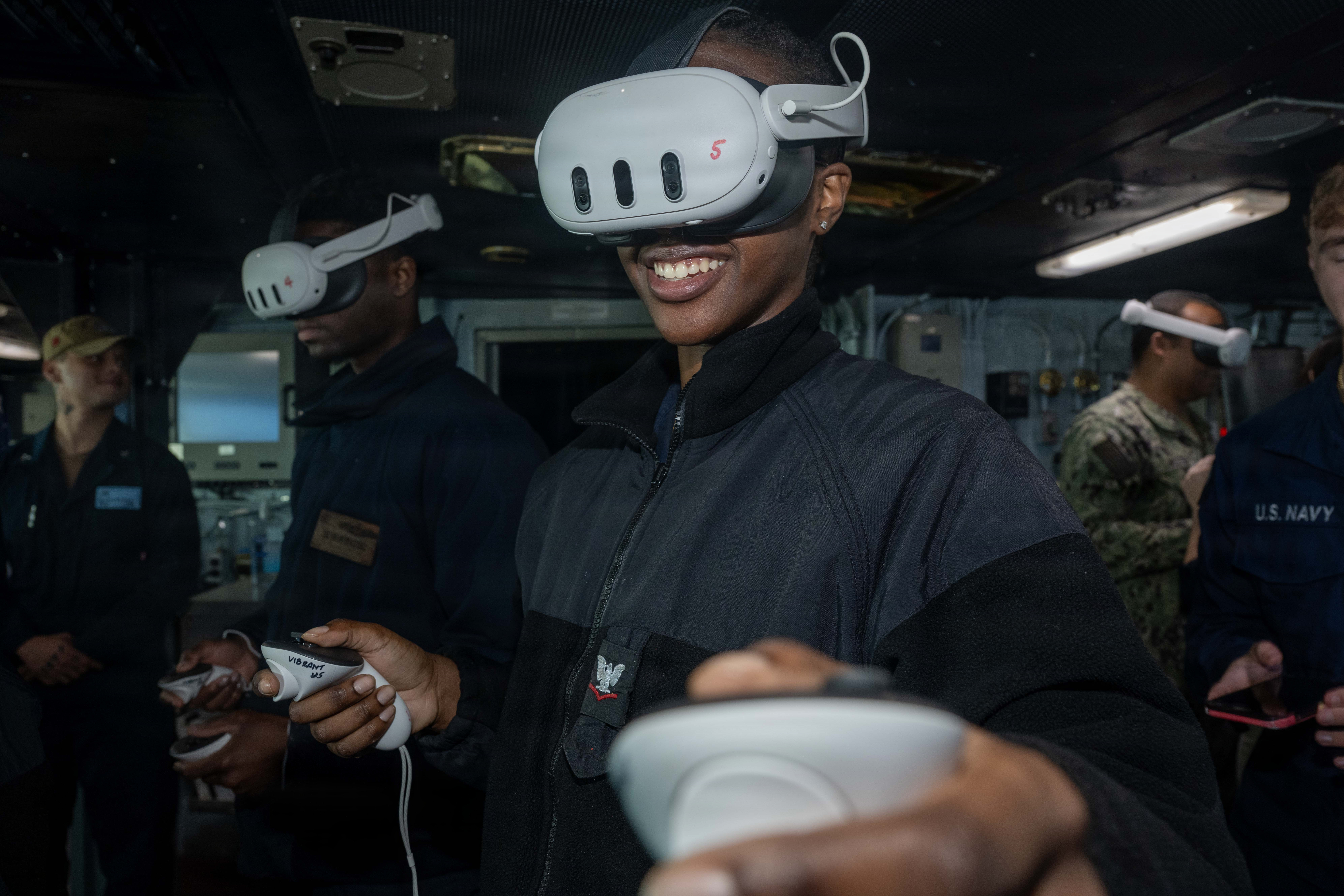
ARLINGTON, Va.—Armed with equipment like virtual-reality goggles and handheld controllers, the Sailors tested their skills guiding a simulated destroyer into various naval ports.
During the exercise, they created multiple challenging conditions such as bad weather and poor light, and designed hazards that included oil rigs, shoals, islands and other vessels.
“This learning system exceeded my expectations,” said one Sailor. “As a visual learner who likes to see and touch an environment before heading into it, I feel this system gives that [ship’s bridge] experience.”
The Office of Naval Research Global (ONR Global) TechSolutions and Naval Information Warfare Center (NIWC) Pacific recently hosted a virtual navigation training demonstration showcasing the Virtual Bridge and Nautical Trainer (VIBRaNT).
The event involved Sailors from Afloat Training Group Atlantic in Norfolk, Virginia, and the aircraft carrier USS Theodore Roosevelt (CVN 71), which was located pierside at Naval Air Station North Island in San Diego, California.
Sailors at both locations were able to interact and practice in a virtual setting, mirroring the bridge of a guided-missile destroyer. Participants experienced firsthand how the TechSolutions-sponsored VIBRaNT system improves the navigation and seamanship skills of bridge watch teams, allowing them to practice rules of the road, rehearse missions and maintain proficiency without visiting a shore-based training center.
“Demonstrating VIBRaNT with personnel separated by a continent — but together in the same virtual environment — showed that teams dispersed geographically can still come together virtually to train on the same bridge at the same time to practice their ship handling and navigation,” said ONR Global TechSolutions Director Jason Payne. “It also highlighted how instructors don’t have to be in the same location, so they can teach from anywhere.”
VIBRaNT is a portable, self-contained training system. It employs commercially available extended-reality hardware — such as laptops, headsets, handheld controllers and wireless routers — and industry-developed software to create a realistic virtual bridge environment.
“We can bring this onboard as a mechanism to have better access for training, increasing the availability to train and providing better situational awareness,” said NIWC PAC Advanced Visualizations Strategy Lead Amelia Kracinovich. “An event like this provides an excellent opportunity to discuss the role of immersive training in maintaining naval readiness and lethality.”
VIBRaNT immerses naval warfighters in at-sea operational environments via virtual scenarios. It offers an ideal way for bridge crews to maintain their proficiency in a virtual setting when the ship is not at sea or when they need to practice unfamiliar ship-driving scenarios. The system also is useful in evaluating how warfighters perform in stressful situations.
Lt. Shamaal Fletcher, a Sailor stationed at El Paso Military Entrance Processing Station, first formed the idea of VIBRaNT two years ago, while he was part of bridge watch teams. He wanted his shipmates and Sailors entering the Navy to have the ability to train where, and when, they needed it.
While conducting online research, he found the ONR Global TechSolutions website and submitted his idea. TechSolutions sponsors the development of rapid prototype solutions based on direct requests from Sailors and Marines, usually within 12 months.
TechSolutions contacted Fletcher shortly thereafter and agreed to help develop the VIBRaNT tool.
Fletcher worked closely with TechSolutions and NIWC Pacific to design VIBRaNT, which is currently undergoing testing and demonstration.
According to Payne, the recent training demo was a success, where Sailors praised VIBRaNT’s design and ease of use.
“Many of them asked if scenarios could be created for various naval ports worldwide as well as different types of vessels, not just destroyers,” said Payne. “The answer to that is yes. VIBRaNT truly represents a valuable investment in warfighting competency through live, virtual and constructive training.”
Learn more about how ONR Global TechSolutions turns Sailor ideas into new technology.
Warren Duffie Jr. is a contractor for ONR Corporate Strategic Communications.