
Delivering the Naval Future Since 1946
The year 2026 marks the 80th anniversary of the Office of Naval Research (ONR). From our beginnings as the first U.S. military organization dedicated to wide-ranging, basic scientific research — to the agile command leading aggressive research portfolios that deliver advanced warfighting capability — our story has always been one of forward-leaning transformation.
Our Legacy
On Aug. 1, 1946, President Harry S. Truman signed the legislation establishing ONR. Under Public Law 588, ONR is mandated to "plan, foster and encourage scientific research" to maintain naval power and ensure national security. We've been focused on and passionate about this mission ever since.
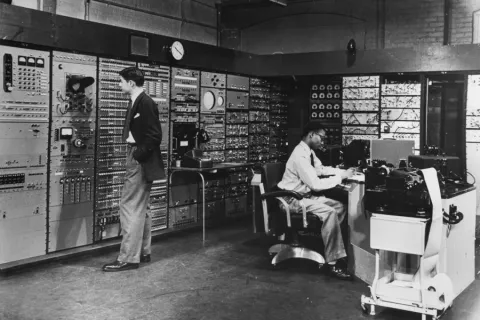
Since its creation, ONR has helped the Navy and Marine Corps meet important challenges through innovations in science and technology (S&T). ONR-sponsored S&T laid the foundation for the first digital, real-time computing systems; brought about the laser and the Global Positioning Systems; supported early groundbreaking research in artificial intelligence and directed energy; supported the early-career research of more than 80 Nobel laureates; helped create the first autonomous vehicles and robotic systems; and many other state-of-the-art technologies that serve the Fleet and Force, and benefit the nation.
Watch our anniversary video celebrating eight decades of naval innovation.
Current Day: ONR-Supported Naval Capability
For 80 years, ONR has been a leader in advancing American naval warfighter readiness and dominance — leading the development of innovative S&T for the Navy and Marine Corps. Some of the most important naval platforms and capabilities began as ONR-sponsored research.
ONR's contributions are essential to the advancement and delivery of combat systems, sensors, weapons, materials, uncrewed platforms and numerous other technologies that provide critical capability for the Fleet and Force. To mark this 80th anniversary, the following graphics highlight naval research's vital contributions to key warfighter capabilities — from surface ships and submarines to aviation and autonomous systems.
These efforts reflect ONR's approach to identifying promising scientific discoveries, maturing innovative technologies and transitioning capabilities to the Fleet and Force. Through partnerships with industry, academia, federal laboratories and naval stakeholders, ONR continues to advance research that helps maintain and advance naval warfighting dominance.
- Arleigh Burke (DDG 51)
- Ballistic Missile Submarine
- F-35 Lightning II
- Marine Littoral Regiment
- Robotic and Autonomous Systems
Download Graphic (PDF 971KB)
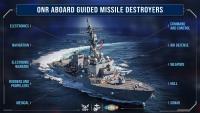
Arleigh Burke (DDG 51)-Class Guided-Missile Destroyer
In its many variants and upgrades, the Arleigh Burke (DDG 51)-class guided-missile destroyer incorporates numerous ONR advances and innovations.
The DDG 51 serves as the primary surface combatant of the U.S. Navy and plays a critical role in missions across multiple warfighting domains.
Research supported by ONR can be found throughout the platform, helping enable the systems and technologies that allow Arleigh Burke-class destroyers to operate around the globe and meet evolving operational demands.
Areas of ONR-supported research and development that can be found on the DDG 51 include:
Cutting-edge advanced materials resulting in a stronger, more durable hull, exterior and interior
Enhanced weaponry, command and control, and electronic warfare to maximize lethal precision
Groundbreaking air defense, navigation and electronics
Medical systems that address warfighter fatigue and readiness and improve survival during casualty events.
Download Graphic (PDF 528 KB)
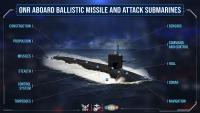
Ballistic Missile Submarine
Today’s nuclear subsurface fleet is the result of 80 years of leadership by ONR in many of the critical technologies found on these vessels. ONR has also provided much of the fundamental knowledge that allows these vessels to operate in the deep sea for months at a time. The result is the world’s quietest, most lethal and most survivable submarines in the world — the cornerstones of maritime supremacy and our strategic deterrence.
Some of the ONR-led innovations that can be found on the subsurface fleet include:
Specialized sensors and systems for enhanced navigation and stealth
Cutting-edge propulsion systems offering greater speed and reliability
Creative construction techniques that reduce production time and life-cycle costs
Improved coatings and design features for stronger hulls
Extensive upgrades to both tactical and strategic weapon systems.
Download Graphic (PDF 424 KB)
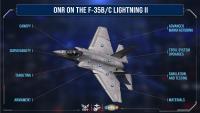
F-35 Lightning II
The F-35 Lightning II is a fifth-generation, multirole fighter that significantly advances the air combat capabilities of the Marine Corps and Navy. ONR, through its Navy Manufacturing Technology (ManTech) program, has made possible significant time and cost reductions related to producing and maintaining the aircraft's critical components — helping to accelarate the delivery of capability to the warfighter.
ONR has made major contributions to the development and improvement of both the Marine and Navy version of the F-35 Lightning II, including:
Upgrades to its air-to-air weaponry
Enhancements to pilot survivability
Improved affordability for the manufacture of the canopy, targeting system and other assemblies
Advances in simulation and testing of complex components.
Download Graphic (PDF 424 KB)
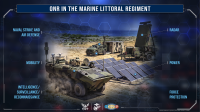
Marine Littoral Regiment
Today's Marine Corps is exemplified by the Marine Littoral Regiment (MLR), a new formation designed for 21st-century challenges. The MLR is designed to operate across contested coastal and maritime environments. Agile, mobile and expeditionary, MLRs are equipped to conduct reconnaissance, sea denial and long-range precision fires in support of naval campaigns.
The littoral regiment takes full advantage of multiple next-generation technologies, many of which are made possible by research, invention and prototypes developed by ONR, including:
Advanced sensors that improve safety, situational awareness and combat effectiveness
Next-generation power generation and management technologies that enhance Marine mobility and logistical independence
Highly mobile light vehicles and expeditionary radars for modern strike and air defense missions.

Download Graphic (PDF 424 KB)
Robotic and Autonomous Systems
ONR has led the development of a new generation of robotic autonomous vehicle technologies that is revolutionizing naval warfare, including the recent establishment of operational unmanned surface vessel squadrons (USVRONs), along with other systems, including:
Long-range autonomous surface vessels capable of a range of missions that have already deployed with the fleet
Advanced materials, sensors and control systems that make vehicles smaller, lighter, more aware, and more mission capable
Advanced power and energy systems that keep vehicles on station for extended periods in a variety of harsh environments
Advances in command and control that have greatly improved human-machine teaming.
Looking Forward
ONR is structuring our S&T portfolio to align with the unique needs of the Navy and Marine Corps and in synchronization with the Department of War's critical technology areas. We are prioritizing our research efforts against real operational problems that are not already receiving private sector investments.
Moving forward, we are targeting our efforts on the following naval-centric, S&T focus areas:
AI and Autonomy
Naval Aerospace
Directed Energy and Kinetic Systems
C5ISE/Naval Space
Human and Biological Systems
Manufacturing
Materials/Electronics
Naval Engineering
Ocean, Atmosphere and Space
Power and Energy
Undersea Systems
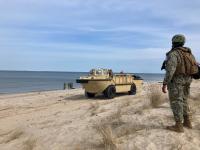
“We start with basic research and partner with industry to educate them on what the Navy and Marine Corps need in terms of readiness and lethality. As technologists, we’re futurists ... We not only think about near-term capabilities but also the naval needs of the future. We think in decades.”
— Chief of Naval Research Dr. Rachel Riley
Explore Opportunities
Are you a researcher who is interested in learning more about ONR and naval S&T? Explore our website to learn more.
-
Visit our current funding opportunities page to view our long-range Broad Agency Announcement — our primary vehicle for obtaining research proposals — as well as to learn about other recent opportunities, to include the FY27 Department of the Navy HBCU/MI Program and special program announcements on topics of interest.
Funding Opportunities
-
Calling all universities: Learn more about the CNR Fellows program — a new and prestigious opportunity for tenured academic research professors that brings nominees to ONR for a one-year fellowship. The initiative is designed to build a growing network of researchers who can help translate naval challenges into immediate S&T research.
CNR Fellows Program
-
Explore our Technology and Research page, where you can navigate the various technology areas to learn about the research we are pursuing.
ONR Technology and Research Areas
Dig Into Our History
ONR has been in the business of pioneering, naval S&T research for 80 years. As we celebrate this milestone, we invite you to learn more about our journey by visiting our history pages. Here, you can view a timeline of our naval innovations, the Nobel laureates we sponsored and access various historical records.
Celebrate With Us
Join us on social media where we will be highlighting stories of ONR's contributions to the Fleet and Force.
Visit us on social media @officeofnavalresearch (Facebook and LinkedIn) and @usnavyresearch (X and Instagram).
Follow #ONR80 to stay up-to-date on anniversary information and activities.