
View ONR’s sponsored technology areas

Explore ONR research funding opportunities

Apply for an ONR contract or grant

Delivering the Naval Future Since 1946
On Aug. 1, 1946, President Harry S. Truman signed the legislation establishing ONR. For 80 years, ONR — including headquarters, ONR Global and the Naval Research Laboratory — has been a leader in advancing American naval warfighter readiness and dominance through innovations in science and technology for the Navy and Marine Corps. Today, ONR’s continued dedication to providing the Fleet and Force with the technological edge is catalyzing the advancement and delivery of combat systems, sensors, weapons, materials, robotic and autonomous systems and numerous other state-of-the-art, naval platforms and capabilities.
What's New
-
Image
ONR today announces the first class of 12 winners in its inaugural Chief of Naval Research (CNR) Fellows program.
Debut Dozen: ONR Announces First Winners of New CNR Fellows Program
-
Image
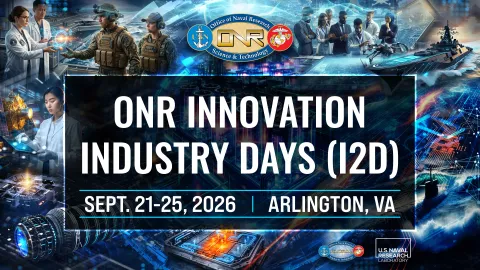
To develop accelerated warfighter capabilities, ONR will host an Innovation Industry Days (I2D) event from Monday, Sept. 21, to Friday, Sept. 25, 2026 in Arlington, Virginia. This multi-day event will spotlight critical science and technology (S&T) roadmaps projected over the next 15 years.
ONR To Host Innovation Industry Days On Sept. 21–25
-
Image
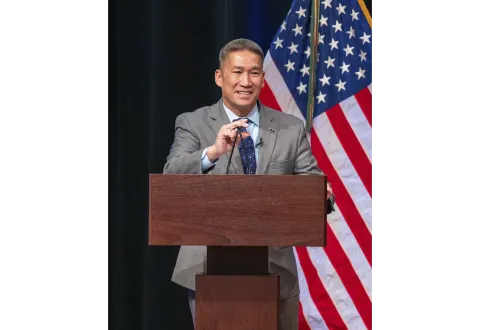
On Friday, July 31, ONR celebrated its 80th anniversary at the Pentagon Auditorium. Together, presenters and participants recognized ONR's legacy of discovery and its role in shaping the future of naval science and technology.
Not Theoretical But Personal: Naval Leaders Celebrate ONR At Anniversary Event
Upcoming Events
-

Monday, Sept. 21, to Friday, Sept. 25, 2026
ONR will host an Innovation Industry Days (I2D) event on Monday, Sept. 21 through Friday, Sept. 25, 2026. The purpose of this event is to communicate and solicit feedback on ONR’s science and technology (S&T) roadmaps projected over the next 15 years.
ONR Innovation Industry Days (I2D)
Departments
-
31
Command, Control, Computing, Communications, Cyber, Intelligence, Surveillance, Reconnaissance and Targeting (C5ISRT) -
32
Ocean Battlespace Sensing -
33
Sea Warfare and Weapons -
34
Warfighter Performance -
35
Naval Air Warfare and Weapons
31
Command, Control, Computing, Communications, Cyber, Intelligence, Surveillance, Reconnaissance and Targeting (C5ISRT)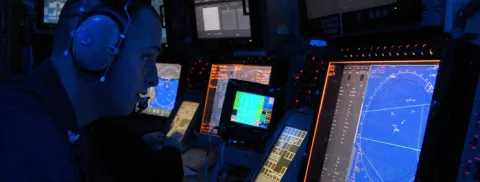
Computers extend warfighter capability in the air, on the ground, underwater and in cyberspace.
The Command, Control, Computing, Communications, Cyber, Intelligence, Surveillance, Reconnaissance and Targeting (C5ISRT) Department supports research in Mathematics, Electronics, Computer & Information Sciences and their applications in Command & Control, Communications, Cyber, EW, Intelligence, Surveillance and Reconnaissance.
32
Ocean Battlespace Sensing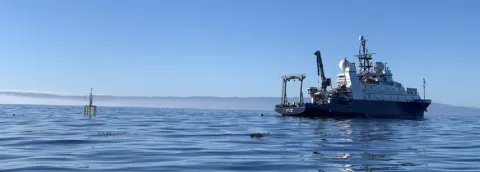
The Ocean Battlespace Sensing Department is responsible for Navy and Marine Corps S&T in ocean and meteorological science, undersea warfare, mine warfare, space technology and marine mammals.
33
Sea Warfare and Weapons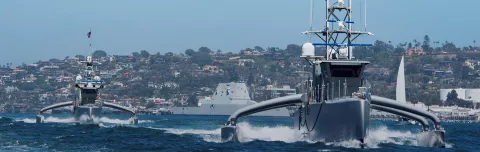
The Sea Warfare and Weapons Department develops and delivers technologies that enable superior warfighting and energy capabilities for naval forces, platforms and undersea weaponry.
34
Warfighter Performance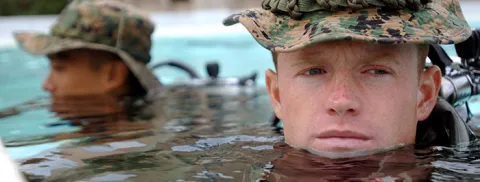
The Warfighter Performance department’s mission is to enhance warfighter effectiveness and efficiencies through bioengineered and biorobotic systems, medical and behavioral technologies, improved manpower, personnel, and training and systems design.
35
Naval Air Warfare and Weapons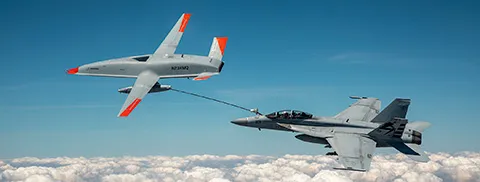
The Naval Air Warfare and Weapons Department supports the Navy’s air warfare and weapons needs, fostering the technology development of naval aviation platforms, kinetic weapons, directed energy and electric weapons.