

Symposium Proceedings
The First Symposium on Naval Hydrodynamics was held in Washington, D.C. on Sept. 24-28, 1956.
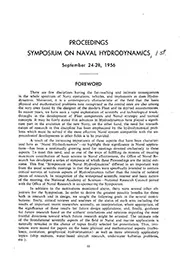
Excerpt from the Symposium Foreword:
There are few disciplines having the far-reaching and intimate consequences in the whole spectrum of Navy operations, vehicles, and implements as does Hydrodynamics. Moreover, it is a contemporary characteristic of the field that the basic physical and mathematical problems now recognized as the central ones are also among the very ones faced by the designer of the modern Fleet and its myriad accouterments. In recent years, we have seen a rapid exploitation of scientific and technological breakthroughs in the development of Fleet components and Naval strategic and tactical concepts. It may be fairly stated that advances in Hydrodynamics have played a significant part in the evolution of the new Navy; on the other hand, the need for intensification of research in this discipline has been emphasized by the hydrodynamical problems which must be solved if the most effective Naval system compatible with the unprecedented developments in other fields is to be provided.
Symposium Papers
This first "Symposium on Naval Hydrodynamics" differed in an important way from the usual scientific meetings in that the papers were specifically intended to contain critical surveys of various aspects of Hydrodynamics rather than the results of isolated pieces of research. Invitations were issued for papers on the basic physical and mathematical aspects (turbulence, cavitation, geophysical hydrodynamics) as well as more obviously applicatory topics (ship motions, water-based aircraft research, underwater ballistics problems, etc.).
The individual presentations delivered at the symposium are provided below in PDF format.
Contribution of Ship Theory to the Seaworthiness Problem. Georg P. Weinblum.
Free-Streamline Theory and Steady-State Cavitation. David Gilbarg.
Hydrodynamic Barriers in Ship Design. J. C. Niedermair.
Hydrodynamic Sources of Sound. H. M. Fitzpatrick and M. Strasberg.
Hydrodynamics of High-Speed Water-Based Aircraft. John B. Parkinson.
Hydrodynamics of Underwater Explosions. Hans G. Shay.
On the Development of the Theory of Marine Propulsion. H. W. Lerbs.
On the Stability of the Laminar Boundary Layer. C. C. Lin.
Physical Effects in Cavitation and Boiling. M. S. Plesset.
Recent Contributions to Basic Hydroballistics. R. N. Cox and J. W. Maccoll.
Remarks on the Ocean Wave Spectrum. W. H. Munk, M. J. Tucker, F. E. Snodgrass.
River Waves. M. J. Lighthill.
Some Current Problems in Turbulent Shear Flows. S. Corrsin.
Some Problems and Methods in Hydrodynamics. L. M. Milne-Thomson.
To Captain H. E. Saunders, USN, Ret. Rear Admiral A. G. Mumma.
Wave Resistance of Thin Ships. John V. Wehausen.
Wave Scattering Due to Turbulence. G. K. Batchelor.